You’re a £100k Electrician How Much Should You Actually Be Taking Home?
If your Xero bookkeeping is three months behind, you might think, “I'll catch up when I have time.”
I've spoken to plenty of tradespeople who look at their bank account, see money coming in every week and think, “I'm doing £100k a year but where is all the money going?”
The answer is that turnover is only the beginning.
What really matters is what you're left with after materials, your van, tools, insurance, subcontractors, other business costs and tax.
So let's look at a realistic example.

First: £100k turnover doesn't mean £100k income
Let's say you're an electrician working as a sole trader and your business generates:
£100,000 turnover
That sounds great.
But imagine your year looks roughly like this:
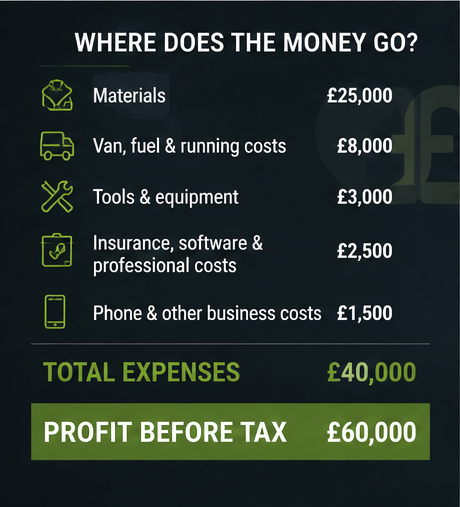
That's the number I'd be much more interested in as your accountant.
Because £100k turnover and £60k profit tells me considerably more about the health of your business than the £100k headline figure.
And even that £60k isn't necessarily what you can safely spend.
So how much can you actually take home?
This is where things get more personal.
Your actual tax bill depends on your circumstances, including your other income, allowable expenses, tax year and how the business is structured.
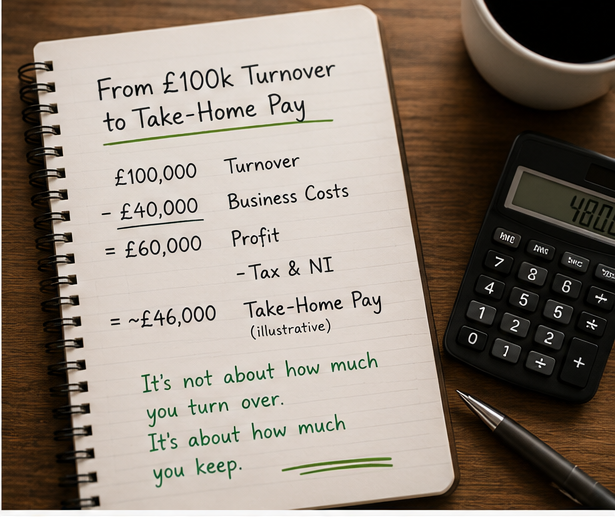
But using a simplified example, a £60,000 taxable profit as a sole trader could leave you with something in the region of £46,000 -£47,000 after income tax and self-employed National Insurance, before considering things such as pension contributions or other personal circumstances.
That's roughly:
£3,850–£3,920 per month
from £100k of turnover.
And suddenly the picture looks very different.
£100,000 turnover
↓
£40,000 business costs
↓
£60,000 profit
↓
Tax & National Insurance
↓
~£46k–£47k personal take-home (Illustrative example only. Your actual position could be materially different.)
But here's the mistake I see tradespeople make
They see £100k coming into the business bank account and think:
“I've got loads of money.”
Then VAT, tax, suppliers, the van and other bills come along.
Suddenly they're wondering:
“How can I be turning over £100k and still feel skint?”
This is usually a cash-flow problem, not necessarily a sales problem.
And it's one of the first things I'd want to understand if you came to me as a client.
What I'd want to know before telling you whether you're doing well
I wouldn't look at turnover on its own.
I'd want to know:
1. What's your actual profit?
Two electricians could both turn over £100k but have completely different businesses.
Electrician A
£100k turnover
£30k expenses
= £70k profit
Electrician B
£100k turnover
£60k expenses
= £40k profit
Same turnover.
Completely different businesses.
That's why I care about your profit margin, not just your sales.
2. How much are you charging?
If you're constantly busy but your profit isn't growing, your pricing might be the problem.
You could have work booked months ahead and still not be making enough money.
I'd want to understand:
your hourly/day rate
your material markup
how you price fixed jobs
how much unpaid time goes into quotes and admin
travel time
cancellations
remedial work
jobs that run over
how quickly customers pay
Sometimes the solution isn't “get more work.”
It might be:
“Charge properly for the work you're already doing.”
3. Are you keeping enough aside for tax?
This is one of the biggest problems I see with growing businesses.
Money arrives in your account.
You spend it.
Then the tax bill arrives months later.
The tax bill wasn't unexpected.
You just hadn't separated the money from the beginning.
One of the simplest habits I'd recommend is having a separate tax/VAT savings account and moving money into it regularly.
That way, the balance in your business account doesn't give you a false sense of how much money is actually available to spend.
4. Are you paying for things you don't need?
This is where proper bookkeeping becomes useful.
It's easy for a growing trades business to accumulate:
subscriptions
insurance policies
finance agreements
vehicle costs
software
equipment
phone contracts
storage
memberships
unnecessary monthly expenses
Individually, they might not look significant.
Together, they can quietly eat into your profit.
Your accounts shouldn't just tell you what happened last year.
They should help you understand where your money is going now.
5. Is £100k turnover actually your goal?
This is a question I think more tradespeople should ask.
You don't necessarily need to chase £200k, £300k or £500k turnover.
Maybe you currently turn over £100k, work six days a week and take home £45k.
Would you rather:
Option A
£150k turnover
More employees
More vans
More admin
More headaches
Similar personal income
or:
Option B
£110k turnover
Better pricing
Better margins
Better systems
Four-day working week
Higher personal income
More turnover isn't automatically a better business.
The goal should be profitable growth, not turnover for the sake of it.
So, what should a £100k electrician actually be taking home?
There's no single correct answer.
Your business might have very different costs from the example above.
A domestic electrician with relatively low material costs will look different from an electrical contractor supplying materials and employing several people.
Likewise, a VAT-registered business needs to think about turnover differently from a business below the VAT threshold.
And once you're employing people or using subcontractors, the numbers change again.
That's why I don't think there's a useful answer to “How much should I take home?” without looking at the actual business.
But I would want you to know three numbers every month:
Turnover
How much you're selling.
Profit
How much the business is actually making.
Cash available
How much money you can realistically use after allowing for VAT, tax and upcoming bills.
Those three numbers tell a much better story than your bank balance.
What I'd do if you were my client
If you came to me and said:
“I'm an electrician turning over £100k. I'm busy, but I don't feel like I'm making enough money.”
I wouldn't immediately tell you to:
“Get more customers.”
I'd first work backwards.
I'd look at:
£100k turnover
→ What are you actually charging?
→ What are your material costs?
→ What does each job actually make?
→ What are your overheads?
→ How much time are you spending on non-billable work?
→ What tax/VAT is due?
→ How much cash is genuinely available?
→ What do you personally want to earn?
Then we'd work out what needs to change.
Sometimes the answer is more work.
Sometimes it's higher prices.
Sometimes it's better cost control.
Sometimes it's a change in business structure.
And sometimes the business is actually doing fine but the owner simply hasn't been looking at the right numbers.

The bottom line
If your trade business turns over £100,000, don't automatically think you're a £100k earner.
Your turnover is the money coming through the business.
Your profit tells you how well the business is performing.
And your personal take-home tells you what the business is actually giving you.
The interesting question isn't:
“How much am I turning over?”
It's:
“For every £1 I generate, how much am I actually keeping and is that enough for the life and business I want?”
That's the number I'd focus on.
Want to know what your numbers actually look like?
If you're a tradesperson turning over around £100k whether you're an electrician, plumber, builder, carpenter, roofer or another trade. We'd be happy to look at the numbers with you.
We'll help you understand where the money is going, what you're actually making and what you could potentially improve.
Need help keeping your Xero or Freeagent up to date?
I provide Xero or Freeagent bookkeeping, accounting and business advisory support for tradespeople who want a clearer picture of their profit, cash flow and overall business performance, with remote support also available across the UK.
If you're spending too much time catching up on your books or simply don't have the time to keep on top of them book a free consultation and let's have a chat about how I can help.
Disclaimer: This article provides a simplified illustration for general information only and is not personal tax advice. Tax rates, allowances, National Insurance and VAT rules can change, and your actual position will depend on your circumstances and business structure.
