Are Your Jobs Actually Profitable? A Simple Guide for Tradespeople

Being busy doesn't necessarily mean you're making good money.
You can have jobs booked weeks in advance, invoices going out regularly and plenty of money moving through the business but still finish the month wondering:
“Where has all the money gone?”
For tradespeople, one of the most useful things you can understand is not simply how much you're turning over.
It's:
How much profit are you actually making on each job?
Because a £5,000 job isn't necessarily better than a £2,000 job.
It depends on what it costs you to deliver it.
Let's look at a simple example.
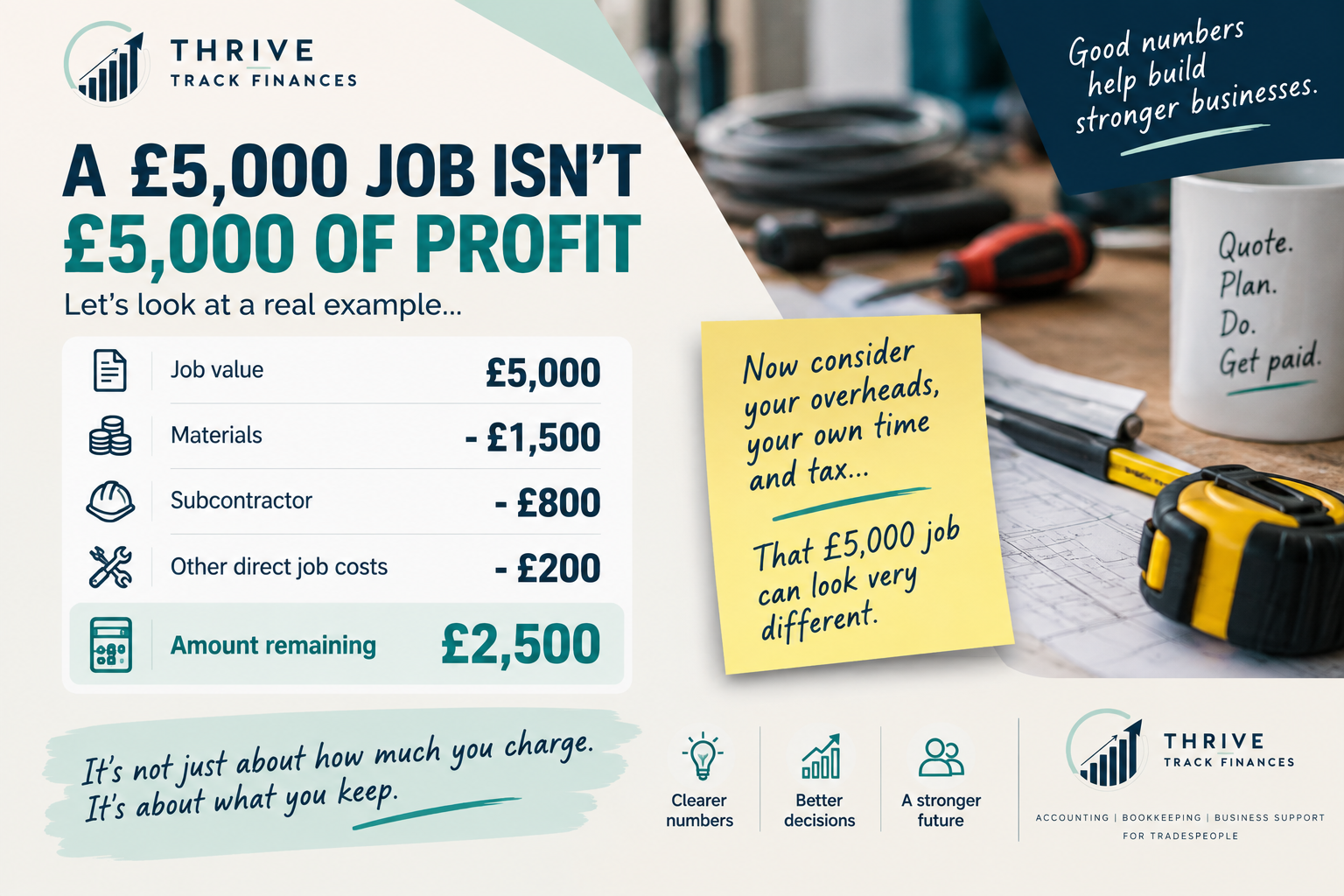
A £5,000 job isn't £5,000 of profit
Imagine you're an electrician and you've quoted £5,000 for a job.
It might be tempting to look at that £5,000 and think:
“That's a good job.”
But first, let's take away the costs.
Job value: £5,000
Materials: £1,500
Subcontractor: £800
Other direct job costs: £200
That leaves:
£2,500
Better.
But we're not finished.
You still need to consider the cost of actually running your business.
Your van.
Fuel.
Insurance.
Software.
Tools.
Phone.
Accountancy.
Advertising.
Training.
Storage.
And, importantly, your own time.
Once you start looking at the full picture, that £5,000 job can look very different.
The cost people often forget: their own time
This is particularly important if you're a sole trader.
Because it's easy to think: “I did the labour myself, so there wasn't a labour cost.”
But your time has value.
Imagine the £5,000 job takes you five working days.
Then there are another:
3 hours preparing the quote
2 hours ordering and collecting materials
2 hours travelling
2 hours dealing with messages and paperwork
Suddenly, the job hasn't just taken five days.
It's taken five days plus another nine hours of your time.
If you're not allowing for that when you price jobs, you might be working considerably more hours than you realise for the profit you're making.
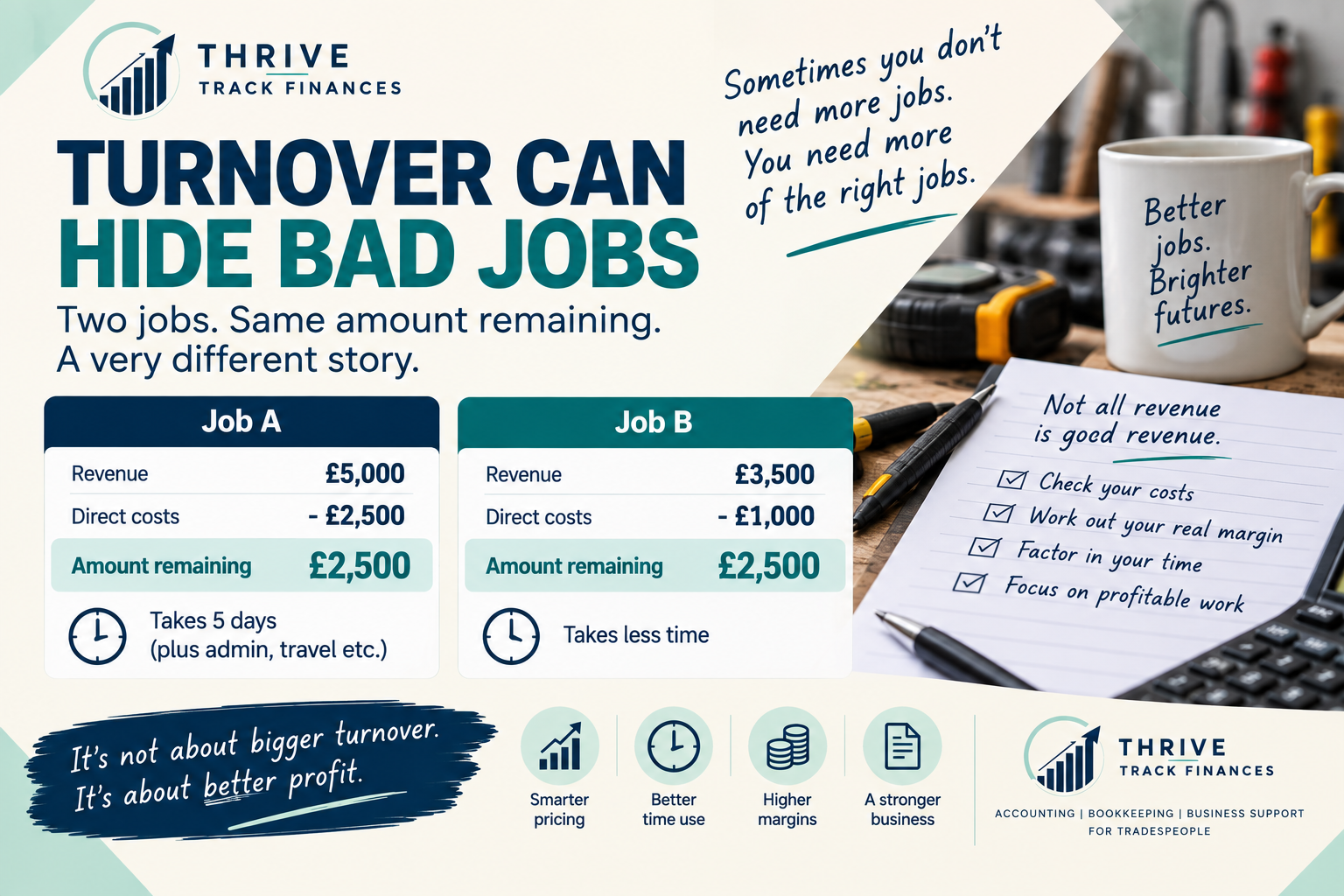
Turnover can hide bad jobs
This is where looking only at turnover becomes dangerous.
Imagine two jobs:
Job A
Revenue: £5,000
Direct costs: £2,500
Amount remaining: £2,500
Job B
Revenue: £3,500
Direct costs: £1,000
Amount remaining: £2,500
Both leave £2,500 before overheads and other business costs.
But Job B generated the same amount from considerably less revenue.
Now imagine Job A also took twice as long to complete.
Which job would you rather have more of?
That's why understanding your numbers can change the way you think about growth.
Sometimes you don't need more jobs.
You need more of the right jobs.

Materials can quietly destroy your margin
Materials are another area I'd watch closely.
Let's say you prepare a quote based on materials costing £1,200.
By the time you start the job, they cost £1,350.
Then you need another £150 of materials you hadn't allowed for.
You've now spent:
£1,500 instead of £1,200.
That's £300 of your expected margin gone.
Do that across ten jobs and you've lost £3,000.
The problem isn't necessarily that the business isn't generating enough work.
The problem could be that the jobs aren't being priced accurately enough.
This is why I'd want a trades business to compare:
What did we expect this job to cost?
versus:
What did it actually cost?
The difference can tell you a lot.

Don't forget your overheads
Not every business cost belongs neatly to one particular job.
Your insurance doesn't.
Your bookkeeping software probably doesn't.
Neither does your accountant, website, phone contract or annual training.
These are your overheads.
And ultimately, your jobs need to generate enough profit to cover them.
Imagine your business has £24,000 of annual overheads.
That's roughly:
£2,000 every month
before you've paid yourself or dealt with tax.
Your jobs need to generate enough margin to cover those costs as well as provide you with the income you want.
That's one reason why simply adding a percentage to materials and charging a day rate doesn't always tell you whether your pricing actually works.
Being busy can sometimes hide the problem
This sounds strange, but being extremely busy can make poor profitability harder to notice.
Money is constantly coming into the bank.
You're constantly buying materials.
Invoices are being paid.
New jobs are starting.
So the business feels successful.
But if nobody stops to look at the numbers, you may not realise that certain types of work barely make money.
Then you reach the end of the year and think: “I've worked harder than ever. Why hasn't my profit increased?”
That's exactly the sort of question good bookkeeping for tradespeople should help answer.
Your bookkeeping shouldn't only exist so that your accountant can prepare your tax return.
It should give you information you can actually use to run the business.
What numbers would I want to know?
If you were my client, I'd want us to understand at least four things.
Your average job value
How much revenue does a typical job generate?
Your direct job costs
Materials, subcontractors and other costs directly connected to completing the work.
Your gross margin
How much is left after those direct costs?
Your overheads
What does it cost to keep the business running regardless of which jobs you're doing?
Once we understand those numbers, we can start asking much better questions.
Which jobs make the best margins?
Which customers or types of work take the most time?
Are materials being marked up appropriately?
Are jobs regularly running over the quoted time?
Are prices keeping up with increasing costs?
And ultimately:
Are you charging enough?
More work isn't always the answer
This is something I come back to frequently.
When a trades business wants to grow, the immediate reaction is often: “I need more customers.”
Maybe.
But imagine you're already doing 20 jobs a month and several of them aren't particularly profitable.
Getting another five similar jobs doesn't necessarily solve the problem.
It might just make you busier.
I'd rather understand the economics of the jobs you're already doing first.
Then we can decide whether the answer is:
higher prices,
better purchasing,
better estimating,
better scheduling,
different types of jobs,
lower overheads,
or genuinely more work.
That's profitable growth, rather than growth for the sake of seeing a bigger turnover number.
Your bookkeeping can help you see this
You don't necessarily need an incredibly complicated system.
But your bookkeeping needs to be accurate and up to date.
With properly organised financial information, you can start comparing periods, monitoring costs and understanding whether your margins are moving in the right direction.
For some businesses, it may also make sense to track different jobs, projects or areas of the business separately.
The objective isn't to produce more spreadsheets for the sake of it.
It's to answer a simple question:
“Which work is actually making me money?”
Because once you know that, you can make much better decisions about what work to take on, what to charge and where you want the business to go.
The bottom line
Being busy is good.
Having plenty of work is good.
Growing your turnover can be good.
But none of those automatically mean you're running a profitable business.
I'd rather see a tradesperson doing £120,000 of profitable, well-priced work than £180,000 of work that creates more vans, more staff, more stress and very little additional profit.
So the next time you're quoting a job, don't only ask: “How much can I charge?”
Ask: “Once I've delivered this job properly, how much am I actually going to make?”
That's the number that matters.
Want to understand which jobs are actually making you money?
At ThriveTrack Finances, we help tradespeople understand the numbers behind their businesses, from bookkeeping and accounting to cash flow, profitability and business performance.
If you're busy but aren't sure whether your jobs are producing the profit they should be, we can help you work through the numbers.
Need help keeping your Xero or Freeagent up to date?
I provide Xero or Freeagent bookkeeping, accounting and business advisory support for tradespeople who want a clearer picture of their profit, cash flow and overall business performance, with remote support also available across the UK.
If you're spending too much time catching up on your books or simply don't have the time to keep on top of them book a free consultation and let's have a chat about how I can help.
Disclaimer: The examples in this article are illustrative and are provided for general information only. Your costs, margins and financial position will depend on your individual business.
